CHARLOTTE’S WEB
SUBJECTS: Science — Biology;
SOCIAL-EMOTIONAL LEARNING: Caring for Animals; Friendship; Grieving; Justice.
MORAL-ETHICAL EMPHASIS: Respect; Caring.
AT A GLANCE: Age: 5 – 8; MPAA Rating: G; Drama; 2006; 96 minutes; Color.
There is NO AI content on this website. All content on TeachWithMovies.org has been written by human beings.

SUBJECTS: Science — Biology;
SOCIAL-EMOTIONAL LEARNING: Caring for Animals; Friendship; Grieving; Justice.
MORAL-ETHICAL EMPHASIS: Respect; Caring.
AT A GLANCE: Age: 5 – 8; MPAA Rating: G; Drama; 2006; 96 minutes; Color.
E.B. White’s book, Charlotte’s Web, is a classic of children’s literature. Most children love this book. Your child’s imagination and verbal intelligence will be stretched if you read the book to your child or, if your child is a good reader, read it together or let your child read it to you. The positive effects of reading Charlotte’s Web will be enhanced if the reading occurs before your child sees the movie, but reading a book expands imagination and exercises language skills both before and after the movie. In addition, reading books is an excellent way to spend quality time with any child. Charlotte’s Web is available at your local library or it can be purchased from your favorite retailer.
The vocabulary in Charlotte’s Web is sophisticated. All children and most adults can improve their vocabularies with this book. Explain the meaning of the words that your child doesn’t know and keep a dictionary by your side, either a book or a computer. If you aren’t sure of the meaning of any word yourself, take the time to look it up. It is excellent modeling for a child to see an adult use a dictionary.

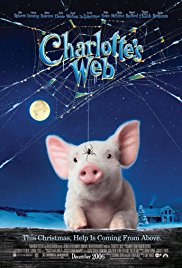
Wilbur, a runt pig, has the great fortune of making two wonderful friends. Fern, a little girl, stops her father from killing Wilbur just after he is born. She argues that it’s not fair to kill the little pig just because he can’t compete with his larger brothers and sisters. A spider named Charlotte creates a sensation by describing Wilbur with words spun into her web. Her goal is to make Wilbur so famous that his owners will not make him into a Christmas ham. Wilbur survives but Charlotte, having lived the allotted time for a spider, spins her egg sac, languishes, and dies. Wilbur takes care of the egg sac for his friend and tells her children all about their mother.
The movie is excellent, following the outline of the book and retaining its message and charm. The filmmakers have added a few characters (the crows) and a few incidents. The movie won the 2006 Critic’s Choice Award for Best Family Film of the Year.
The lessons of this story include: the possibilities of affection between individuals of different species; acceptance of individuals who are different (that we must look behind appearance to see the true worth of an individual); the value of friendship; and acceptance of the natural rhythms of life. As Charlotte says, “After all, what’s a life, anyway? We’re born, we live a little while, we die.” The story also allows children to begin to see human beings from the animal’s point of view.
“Charlotte’s Web” can also interest kids in learning about pigs and spiders.
MINOR. There are a few burp and fart jokes. There is a fleeting view of Fern and her brother Avery standing in the back of the pickup truck as it heads toward the fair (a problem that can be corrected during the movie, by explaining how dangerous that is). Fern and Avery go off on their own at the fair, though this is approved by their parents, and if they aren’t together, Fern is with her friend. Finally, Charlotte’s death is sad, but tasteful and touching.
The movie features the following words that may be new to a child: litter, runt, nocturnal, chat, converse, address (as in “Will the party who addressed me last night at bedtime kindly speak up”), salutations, cured (two meanings, one referring to getting well and the other referring to smoking a piece of meat), radiant, terrific, humble, languish, and magnum opus.
Was there a real Wilbur the pig? — Yes, there was, but he didn’t have a name. E.B. White, the man who wrote Charlotte’s Web, would raise a spring pig every year and slaughter it around Christmas time. This was many years ago and lots of people did that back then. One year, the pig that Mr. White was raising got sick and he had to take care of it. Mr. White observed that the pig had a real personality and that it suffered when it was sick. The pig and Mr. White became good friends but the pig never recovered. Eventually it died of the sickness. Mr. White never again looked at pigs as just something to keep confined, to feed, and then to kill for food. As a result of his friendship with the pig who got sick, Mr. White wrote the book Charlotte’s Web.
Did you know that pigs are smarter than dogs? — They love their babies and can feel affection for people. Pigs can be house trained just like a cat or a dog. There are some people who keep pigs as pets.
If you were Fern, would you have wanted to save Wilbur? Why?
If Charlotte were to write words in her web to describe you, what would she write? — Why did you select those words? — What would she write about me?
→ Always encourage your child to form opinions and to share them.
→ Open-ended questions will help get a discussion going.
Why didn’t Charlotte come back to the farm after she finished storing eggs in her egg sac?
→ Just talking with your child fosters verbal, social and emotional learning.
→ Exercise memory skills by asking about the story, the characters, and the plot. Keep it light and fun.
Have you ever seen a real spider’s web sack? When was that?
→ Young children love Story Time.
Select questions appropriate for your child.
1. Did you notice how all the animals worked together to try to save Wilbur? What did each of them do? Talking About It — Charlotte spelled the words in her web. Wilbur looked cute. Templeton found things that helped Charlotte think of the words. The other animals suggested words for Charlotte’s web.
→ When a parent takes a concept from the movie seriously, a child will start thinking about the lessons of the film. Often, it only takes one comment to start a child’s mind going.
2. Can you name some characters in this movie who you didn’t expect to be friends, but who became good friends? What does this tell us? Talking About It — The sets of characters could include: Fern and Wilbur, Wilbur and Charlotte, Templeton and the farm animals. This tells us that the most important thing in finding a friend is not how they look or how they are different from us, but who they are on the inside and whether we like to be together.
→ You can talk about a movie at any time: right after it is over, in the car on the way to school, during quiet time, or before bed.
3. How can we show our respect for animals? Talking About It — There are lots of different ways: some people don’t eat meat (they are called vegetarians), some people don’t use things made from animals (like leather purses or shoes) and there are other ways, too. We can approach other people’s pets kindly and gently, we can not step on or kill bugs (remember how important Charlotte, a spider, was to the farm? What would happen if all the spiders were gone?), we can volunteer our time at a pet shelter and play with the pets waiting to be adopted. What other ways can you think of?
→ Don’t feel obligated to cover everything in this Guide. One or two questions are all that some children will tolerate. However, if your child watches the movie more than once, on each occasion start a new conversation or pick a new activity. This will enhance verbal development and increase the number of lessons your child takes from the film.
4. Do spiders do anything that helps people? Talking About It — They kill and eat flies, mosquitoes and other insects.
1. Wonderful Words — Templeton found scraps of paper with words for Charlotte to use in describing Wilbur. With your child, collect things from around the house that have words printed on them such as cereal boxes, magazines, junk mail, empty bottles with the labels still attached, and newspapers. Cut out, or write onto paper, words that describe a pet, your child, a friend, or a relative. Try to find words that are just a little more difficult than words that your child already knows. Explain the meaning of these words. If there are any that you don’t know, look up the meaning and pronunciation in the dictionary. Get a piece of paper and help your child put the new words into a sentence describing the person you have selected. You can have your child write this sentence down. You can also play games online which are based on the wonderful words in “Charlotte’s Web”. Visit Gamequarium for vocabulary games broken up by the chapters of the book.
2. Charlotte’s Webs — Remember how amazing it was when Charlotte wrote words into her web? You and your child can do the same thing . . . just a bit differently. Start with a piece of construction paper. Trace an outline of a web with a pencil, and work with your child to come up with a word that describes a pet, your child, a friend, or a member of your family. Words such as fun, loyal, and loving are examples. Fit this word into the web, then trace over the pencil outline with a thin line of white glue. (Don’t use a glue stick, you want a thin line.) Have your child shake glitter over the glue lines. Use lighter glitter for darker colored paper, and darker glitter for lighter paper. Then hold the paper up and shake off the excess. (Be sure to do this outside, on a craft table, or over some newspaper.) Wait for your wordy web to dry, and then hang it in a window or on a wall or bulletin board. Then repeat this for other pets, members of your family, or for friends. (Instructions adapted from Enchanted Learning’s Halloween Crafts.)
3. Animal Guessing Games — Think of an animal (start with an easy one like a dog or a cat) and give small clues until your child can guess what it is. For instance, it has a furry body, it has four legs, it likes to play fetch, etc. You can make the animal more and more difficult to guess (donkey, lizard, koala) and you can also turn this into a “20 Questions” type game, by having your child think of an animal (and keep it secret). You can ask questions about the animal, but only questions that can be answered with a “yes” or a “no” Such as, does it walk on four legs? Can it fit in the car? Does it like to drink milk? Make sure to reverse the roles, so that both of you can do some guessing!
Stories are essential tools for verbal development, social-emotional learning, and character education. Intentional parents can use family movies as a basis for storytelling.
Repeat the story of Charlotte’s Web, the book or the movie, at bedtime, on a rainy day, or at any quiet time. Let your child correct you if you make a mistake and, better yet, encourage your child to tell you the story. Both of you can invent new adventures for Fern, Wilbur, Charlotte and all their friends. Your child’s imaginative and verbal capacities will be enhanced if you invent new characters and create situations that are not in the movie. To learn more about enhancing growth and development through stories told to children, go to How to Tell Bedtime Stories . . . Any Time.
Here is a bedtime story about the themes in “Charlotte’s Web” that you can read to your child.
My name is Maria and I live in Pomona, a small town not far from Los Angeles. This is the story of a field trip my class took a few months ago, just after we had finished reading “Charlotte’s Web”. Our teacher, Mr. Anderson, told us we’d visit a farm. He promised that we’d see pigs, cows, chickens, and sheep. He said the farm was a sanctuary. At the time, I didn’t know what that meant.
Everyone was excited about the trip. Right after Mr. Anderson finished talking, Jason, one of the boys, clapped his hands and yelled out, “Bananas!” Jason was the most annoying boy I’d ever met. He couldn’t keep his mouth shut and he’d do anything to get the other kids to laugh. He had to sit in the front row so that Mr. Anderson could keep an eye on him. Every so often, Jason said something that simply made no sense. What did bananas have to do with a farm?
Jason had light blond hair and freckles on his arms and face. His ears stuck out from the side of his head. The next thing I heard was Jason again, “Is that the farm where cows lick your face? Yuchhhh!” He turned in his seat so that we could all see him and made a really gross face. Then he pulled on his ears so that they stuck out even more and shook his head quickly back and forth saying, “Yuchhhhhhhhhhh! Slimy!” All the kids laughed.
“Are we going to see Wilbur?” asked one girl.
My best friend, Annie, called out, “What about Charlotte? Is there going to be a spider who spells with her web?” Annie sits across the room from me. She has long brown hair in a pony tail. We all knew that we wouldn’t see Wilbur and that spiders can’t spell. We were just having fun.
Then Jason said, “Maybe we’ll see a web that spells” and here he tried to make his voice sound like a vampire, “Come to me fly. I’ll drink your blood!” He faced the class again and put his top teeth over his lower lip, trying to look bloodthirsty. The class laughed again.
When Mr. Anderson got annoyed, he would straighten his glasses with his left hand. He did that now and raised his right hand. He didn’t say a word. This was the signal for the class to be quiet. The kids settled down, and Mr. Anderson said, “Now, I want you to be respectful to the animals. We’re going to see a lot of them close-up. It will be interesting.”
I looked across the room at Annie, and she glanced back at me. We hoped that Mr. Anderson would let us be field trip partners. We are more than best friends. We’d been born on the same day, in the same hospital, and we’d grown up on the same street. We played together almost every day. As a result, our teachers never let us sit together in class. “You’ll just talk and won’t learn anything,” they said.
After school, Annie’s mom picked us up. In the car, we told her about the field trip and Annie said, “I hope they don’t kill pigs at this farm.”
Annie’s mom said, “Don’t worry, honey. It’s a sanctuary. They don’t kill animals there.”
On the day of the trip we had to get to school an hour early. Mom made some of her special hot chocolate . . . a treat that she usually made only on holidays! When we got to school, Annie and I stood around with the rest of the class waiting for the bus. The early morning was bright and cool and we shivered a little in our light jackets.
Mr. Anderson was pairing students for the day and making notes on a clipboard. “I know you two want to be partners,” he said to us, “and since it’s a field trip, I’m going to put you together. . . . But I also want you to sit with Jason and to stay with him at the sanctuary. Don’t let him get into any trouble.”
The joy that Annie and I felt about being paired sank right to the ground at our feet. “Not Jason, Mr. Anderson,” we said together.
“He’s so annoying,” I explained.
“It’s up to you, girls,” Mr. Anderson said, adjusting his glasses. “If you want to sit together, you have to make sure that Jason doesn’t get into trouble. Besides, he’s not so bad once you get to know him. He just doesn’t know how to make friends. That’s why he tries to make everyone laugh all the time.”
Being together was worth putting up with just about anyone, so we agreed.
Mr. Anderson told us to sit on the long seat at the back of the bus. Just as the bus started to leave, Jason tried to make a joke, but I glared at him and told him to be quiet. After that, he didn’t say a word and just sat there staring straight ahead. That was a relief.
As the bus turned into the farm, I had an idea about how to punish Jason for the fact that Mr. Anderson made us spend the day with him. I started with, “Hey, Jason, is it really true that a kid got licked by a cow?”
“Sure, it happened to a kid in Mrs. Chen’s class. Last week they went to the same farm we’re going to.”
I said, “Well, I don’t believe you. I’ve never heard of cows licking people. I think you made it up.”
“I didn’t make it up. That’s what he said. And cows do too lick people.”
Annie joined in, “No, they don’t. They eat grass. Who ever heard of a cow licking a person?”
“They do, too. That cow licked Juan. You can ask him.”
I said, “I wouldn’t believe a friend of yours and I don’t believe you. But if you want to prove it, why don’t you get yourself licked today?”
Jason’s face fell. “I never said I got licked by a cow. I said Juan got licked. And he’s not my friend, he just told me that.”
Annie smiled at Jason. “I know, but Juan’s not here to back you up, even if we would believe him . . . which we wouldn’t anyway. And he’s still alive isn’t he? He didn’t die from getting licked by a cow.”
This was too good. I said, “I’ve got a used Kleenex if you need to wipe your face. If you’re so sure this happened, why don’t you prove it? And then you’d be the only one in class who’s been licked by a cow!”
“Well . . . ” said Jason. I was amazed; he was actually considering it. “If I go up to a cow and get a lick, will you go next? Same thing, full in the face?” Annie gave me a poke in the ribs and shook her head, “no way”.
Well, I had to think about this. First, I had no intention of allowing a big old cow to lick my face. But also, I knew that Jason was bluffing. He’d never go through with it.
“O.K.” I said. “If you do it, I’ll do it, too. But I bet you don’t have the guts to get close enough to a cow so that she can lick your face.”
By that time, the bus was pulling into the parking lot of the farm. It had a stone house and a large red barn, just like other farms. Fields separated by fences stretched out in all directions. A man in coveralls, with white in his hair and a red bandana on his neck, waved to us.
Soon the entire class was standing in front of the house and the man with the coveralls and bandana talked to us. “This farm is different because we don’t kill any animals, we don’t send them to the slaughterhouse, we don’t milk the cows, and we don’t take the wool from the sheep. This is a farm for the animals, so that they can live out their normal lives in peace. It’s a sanctuary farm.”
“Where do you get the animals from?” Mr. Anderson asked.
“If an animal is lucky enough to escape from a slaughterhouse, the police will sometimes bring the animal here. Sometimes, we go to the slaughterhouse. They aren’t allowed to sell the meat of an animal that can’t stand up, so they don’t go to the expense of killing them. They call them ‘downers’. We take those animals and nurse them back to health and they live here.”
Annie raised her hand. “What about Wilbur the pig? Do you have Wilbur here?” Some of the kids giggled. Mr. Anderson frowned and adjusted his glasses.
“Yes, we have a pig here named Wilbur. He’s not the pig in the story. He’s one of our heroes because he broke out of a cage when they were taking him to the slaughterhouse and went running down the street.”
Mr. Anderson said, “O.K. class, we’ve got a free hour. You can go and look at the animals. Be careful and be respectful. The people in blue T-shirts are volunteers who gave up their day to take care of the animals. You can ask them any questions you want. Remember to meet back here in an hour.”
“Come on,” I said to Jason, “Let’s go find your cow.” He swallowed hard.
“You’ve got to do it, too,” he said.
“But, you’ve got to do it first,” I replied. It seemed as if Jason looked kind of pale, except for his ears which seemed to be a little red.
The barn was close to the house and dark inside. It had the dry, crisp scent of straw and the heavy, dark-wet smell of cow droppings. At first, coming in from the sunlight, it was hard to see and the only thing we could make out was the huge white face of a very large, scary cow. This cow was twice as tall as Jason or me and white all over. It looked as if it was as big as a truck. I’d never seen an animal that size in all my life, except maybe the elephant at the zoo. Its face alone must have been two feet long and it seemed a lot bigger looming out from the dark of the barn. The massive cow just stood there, its jaws working, chewing and chewing.
We all stopped. Annie said, “Wow!”
Jason turned to walk out of the barn, but I pushed him toward the cow and said, “Oh, no you don’t! Meet the cow that’s going to give you a big fat lick.” Jason’s face was white, almost as white as the cow, except for his standout ears which were now bright red. He didn’t say a word.
“Hi kids, what’s up?” It was one of the farm volunteers. She was tall with close cropped black hair. She looked about the same age as my cousin who’s in college, but I have trouble guessing the ages of older people. She wore the bright blue shirt of a volunteer at the farm. She patted the side of the cow. “You want to meet Bessie? She’s my favorite cow on the place. My name is Raisha. What are your names?”
Annie answered. “I’m Annie and this is my best friend, Maria. And this is Jason. He wants to get licked by a cow. What’s your name again?”
“Raisha,” said the volunteer. She looked at Jason and grinned. “Are you all right? You seem kind of pale.”
Annie said, “Raisha, they’re here on a dare. Maria dared Jason to get licked by a cow and he dared her back. So, if he gets a lick, she has to get the next one.”
Jason looked sick and the sicker he looked, the better I felt.
“Well,” Raisha said, “Who’s going first?” She looked from Jason and then to me. Neither of us moved.
Annie came to my rescue, kinda. “He’s going to go first, and then Maria.”
Raisha came up to Jason and said, “O.K. Jason, let me tell you why I like old Bessie so much. She’s about ten years old. She was a dairy cow, and for years, she was hooked up to one of those electronic milking machines. For five long years she lived that way, and each year the dairy farmers got her pregnant and each year when she had her baby, they took it away, and each year Bessie mourned for her baby. The dairy farmers keep their cows pregnant because it means they’ll give more milk, but the baby gets taken away just after birth. And then, when Bessie stopped producing a lot of milk, the farmer was going to sell her to a company that would grind her up for hamburger. But when they came to take her to the slaughterhouse, Bessie was so tired and worn out from giving milk all those years that she had fallen down and couldn’t get up. And so, the farmer called the sanctuary and we brought her here. That was about four years ago. She’s a healthy cow now. She’s even got a new baby to take care of. It’s an orphan goat named Punkie. Bessie takes care of Punkie like she was that goat’s mother.”
Annie said, “Will she lick him?” Annie wanted to see Jason run away like a coward.
“Oh sure,” said Raisha. “Bessie gives great kisses.” She came up to Jason, took his hand, and started to lead him to the cow.
Now was the time. I expected Jason to bolt and run — but he didn’t. Raisha talked to him softly. “Now don’t be afraid. I’ll be with you the whole time. Bessie and I are good friends and she’s the gentlest old girl you’ll ever meet.”
Jason was still pale and his ears were redder than ever, but he didn’t run away.
Now I got nervous. I could feel sweat dripping down my back, and my knees were a little weak. Was he really going to do it?
“Put your hands up to the sides of her face . . . very gently. That’s the signal that you want a kiss.”
I still expected Jason to turn and run, but his hands slowly moved to the side of the cow’s face. I saw her tongue, large, gray and rough, move from the bottom of Jason’s face to the very top. After the cow had licked him, Jason stood there for a minute with his hands up on the sides of the cow’s face just looking at her. Then he turned toward me, his eyes glistening with tears.
He said in a soft voice, “You don’t have to get licked Maria, if you don’t want to. It’s O.K.” He said to Raisha, “Thank you.”
Well, I couldn’t let Jason go back to school and say that I’d run out on a dare, and anyway, the lick hadn’t seemed to hurt him. He actually seemed to like it. Why should it hurt me?
As Raisha took me by the hand, Jason whispered in my ear, “It’s her eyes. Look into her eyes.”
Well, I got kissed that day by Bessie. A large gentle tongue licked my face — and I looked into deep, brown, sad eyes that were full of love.
Annie got kissed that day, too. Afterwards, she, Jason and I spent the rest of the hour helping Raisha get straw for Bessie. It was one of the best times I had all year.
And Jason? Well it turns out that Jason isn’t so bad after all. Since our trip to the sanctuary, Annie and I hang out with him quite a bit. He doesn’t say strange things anymore, but he still likes to make kids laugh. In fact, most of the time, he’s a pretty funny guy.
The end.
Other stories by E.B. White include Stuart Little and The Trumpet of the Swan. You can find these books online or at your local library.
Children who love this movie might be interested in Babe or The Adventures of Milo and Otis.
Written by James Frieden and Lauren Humphrey.