

|
NEW THIS MONTH (MAY 2013)
THREE NEW LEARNING GUIDES:
|
New Learning Guide based on the movie COVE
Description: This is the 2010 Academy Award winning documentary exposing the annual dolphin hunt that occurs at a cove in Taiji, Japan. Dolphins are herded into the cove and trapped there by nets. Some are selected for transfer to dolphinariums throughout the world to be trained to entertain crowds of people. The remainder are slaughtered for their meat. Set up as a thriller, the movie follows the film crew as it tries to evade obstructions set in place by the Taiji fisherman and the government of Japan to stop them from filming the capture and slaughter.
Rationale for Using the Movie: This film is an exposé of cruel treatment of a very intelligent ocean-living mammal. When shown with the lessons provided in this Learning Guide the film provides opportunities for learning on several additional levels.
View the new Learning Guide to COVE.
|
A New Learning Guide to the Documentary FORKS OVER KNIVES
Description: Physician T. Colin Campbell, raised on a dairy farm, enjoyed a diet of meat and milk products until he became involved in a study that looked for causes of the "diseases of affluence": heart disease, cancer and Type-2 Diabetes. At the same time, noted surgeon, Caldwell Esselstyn, also raised on a dairy farm, noticed that a year or two after he performed arterial by-pass surgery, the arteries of many of his patients were filled again with cholesterol. Both men, independently, came to the conclusion that a whole-foods plant-based diet could stop the progression of these diseases and in some cases, reverse them. This knowledge has been synthesized in Forks Over Knives.
Rationale for Using the Movie: In order to make intelligent decisions about their diet, students need to know the information presented in this film. In addition, as schools adjust their lunch menus to offer healthy choices and as school boards are banning soda and candy machines from campuses, students need to understand what drives the changes in the food choices they are being offered.
View the Learning Guide to FORKS OVER KNIVES.
|
|
|
New Learning Guide based on the movie MIDNIGHT IN PARIS
Description: Hollywood screenwriter, Gil Pender, is trying to write a novel of literary significance. Vacationing in Paris with his fiancé and future in-laws, he is overwhelmed by nostalgia for the period of the Lost Generation, the 1920s, when brilliant American writers and visual artists from all over Europe lived and worked in Paris. While taking a midnight stroll Gil is magically transported to the 1920s where he meets Hemingway, F. Scott Fitzgerald, Salvador Dali and other famous writers and artists of the period. Through these encounters Gil learns that he needs to change the course of his life and that although he must live in the present, he can shape his life according to the values that had drawn him into the past.
Rationale for Using the Movie: This film can provide benefits on at least three levels. It allows students to visualize famous writers and artists who worked in Paris during the 1920s. The story itself is valuable, raising the issue of how best to use the past. It can also serve to acquaint students with the City of Paris, one of the great cities of the world.
View the new Learning Guide to MIDNIGHT IN PARIS.
|
APRIL 2013
TWO NEW LEARNING GUIDES & ONE LESSON PLAN:
|
New Learning Guide based on the movie ARGO
Description: This is the story of the rescue of six American diplomats who escaped when Iranian militants seized the U.S. embassy in Tehran in 1979 and took the embassy staff hostage.
Rationale for Using the Movie: The film can serve as the basis for discussion and writing with respect to the risks and benefits of using movies as historical fiction. With careful scaffolding, the film can also be a platform from which students can explore lessons about the risks of causing regime change in other countries and U.S./Iranian relations since WW II.
View the Preview Learning Guide to Argo.
|
A New Learning Guide to the classic film Of Mice And Men
Description: Set in Depression era farm country, this film adaptation of John Steinbeck's novel opens as George and Lenny flee authorities after Lenny, who is mentally disabled, appears to have assaulted a woman. Lenny is incapable of understanding that his desire to caress something soft can easily be seen as threatening. George is his friend and protector. They eventually find work at a ranch where Lenny runs into similar but more serious trouble, the results of which cannot be escaped.
Rationale for Using the Movie: In its fairly accurate portrayal of the characters and themes presented in Steinbeck's novel, the film illuminates the conflicts between self-interest and loyalty as it explores the limits of friendship.
View the Preview Learning Guide to Of Mice And Men.
|
|
FEBRUARY / MARCH 2013
|
A New Lesson Plan based on the movie SHAKESPEARE BEHIND BARS
Description: Murderers, thieves and a child abuser, in prison on long sentences, seek self-discovery by playing roles in a production of Shakespeare's great last play, The Tempest. Since actors in Elizabethan times were considered to be criminal low life, Shakespeare would feel right at home with this troupe. As they prepare for performance, the men reflect on their crimes and the meaning of forgiveness while discovering remarkable parallels between their own lives and the experiences of the characters they play.
The film can be used as an interesting introduction to The Tempest or as a follow-up after studying the play. Shakespeare Behind Bars is also useful on its own.
View the new Lesson Plan to Shakespeare Behind Bars.
|
A LESSON PLAN ON SOCIAL SATIRE featuring THE INVENTION OF LYING
The spirits of Aristophanes, Voltaire, Jonthan Swift, and Mark Twain are alive and well in the movies. This Lesson Plan, suitable for any work of social satire, but based on Ricky Gervais' The Invention of Lying, contains background, more examples of social satire in various media,discussion questions and assignments to assist teachers in presenting a short unit on social satire.
Description of the Movie: This warm-hearted comedy presents an alternate universe which is the same as the modern day U.S., except that no one knows how to lie and everyone speaks exactly what comes into their heads. There are no "white lies," there is no fiction, and everyone can be absolutely trusted. There is also no religion.
As the movie opens, the audience is introduced to Mark Bellison, a slightly overweight young man with a pug nose who is unsuccessful at work and unlucky in love. In short order, Mark is rejected by a beautiful woman, gets fired from his job, and is about to be evicted from his apartment. The movie shows how Mark discovers the ability to lie while poking fun at modern society and some of our most cherished institutions.
View the lesson plan on Social Satire.
|
|
|
PLEA BARGAINING IN THE AMERICAN JUSTICE SYSTEM
A Snippet Lesson Plan based on the movie AMERICAN VIOLET
Learner Outcomes/Objectives: By watching a 31 minute clip from the movie and through class discussion and assignments, students will learn about plea bargaining, the public policy decisions on which it is based, and some of the problems with the practice.
Rationale: The U.S. criminal justice system is primarily a system of plea bargains. 95% of all persons prosecuted for crimes in the U.S. end up pleading guilty in return for reduced charges or a lighter sentence. This lesson plan will provide students with a vivid illustration of the strong pressures that are brought to bear on defendants to plead out, regardless of whether they are guilty.
Description of the Film Clip: This film is a fact-based account of a young African-American mother arrested in a racially motivated drug sweep by a Texas county district attorney. She resists pressure to agree to a plea bargain.
View the new Snippet Lesson Plan on Plea Bargaining.
|
AUGUST 2012
NEW LEARNING GUIDES TO THE FILMS 127 HOURS & THE HELP:
WRITING LESSON PLAN USING THE FILM 127 HOURS
Your arm is pinned by a giant boulder to the rock wall of a canyon in the remote desert...
Description of the Movie: 127 Hours, adapted from Aron Ralston's book Between a Rock and a Hard Place, describes five days during which a giant boulder pinned Ralston's arm to the wall of a slot canyon. Trapped and with no hope of rescue, Ralston musters the courage to break the bones in his arm and then to sever the flesh from his body.
The "TWM Writing Lesson Plan Using 127 Hours" employs an innovative student handout to describe some of the concepts in Ralston's book. The handout is to be read before students watch the movie — or, since tne essentials of Ralston's story can be told in a few short sentences, instead of watching the movie. Each section of the handout introduces an idea that helps readers understand Ralston's harrowing decision to cut off his arm and give himself a chance to walk away from certain death.
Suggested assignments are designed to encourage students to write freely in response to the information given and to empathize with the attributes of character that served Ralston so well. Then, as students watch the film, they will be able to see how ideas they have considered and written about are described visually.
View the Writing Lesson Plan Using 127 Hours.
|
|
|
LEARNING GUIDE TO THE HELP
Among the many stories about racism, The Help is unusually valuable because it demonstrates how prejudice distorts important personal relationships such those of primary caregiver and child, parent and child, girlfriend and boyfriend and between friends. Anyone who reads or sees "The Help" will never again believe the "Mammy" stereotype.
For ELA classes, the movie is an excellent opportunity to study character development over the course of a narrative. For U.S. History classes
the film is a valuable addition to a list of movies to be watched as homework to explore segregation, Jim Crow and racism in the 20th century or as an exmaple of the genre of historical fiction. See TWM's Historical Fiction in Film Homework Project
Objectives/Student Outcomes Using this Learning Guide: Students will engage in an analysis of character development in a popular story and will exercise their writing skills on a topic that interests them. They will become aware of how racism and classism distort human relationships and of the segregated society which existed in America as late as the 1960s.
The Learning Guide to The Help will assist in teaching from both the movie and the book.
View the new Learning Guide to The Help.
|
LATEST TWM BLOG POSTS:
TWM Moves to Facilitator – Learner Model
Posted: August 6, 2012
Written By: Mary Red Clay (TWM contributor)
Summer sails past and soon educated grown-ups will be preparing for their roles as teachers of youngsters, as has been happening ever since some farmer decided his kids needed to be home when the crops were ripe. Peculiar, isn't it, that we still follow the agrarian calendar. More peculiar still is that we consider teachers to be living textbooks, full of vital information that must be delivered to their students. In the "information age" this notion is absurd. Teachers will better serve their students if they become "facilitators" of instruction and guides to the process that students use to seek knowledge on their own....[ click here to continue reading full post ]
JULY 2012
MORE NEW LEARNING GUIDES COMING SOON:
— Coming in August we will have two brand new Learning Guides to the movies
127 Hours and The Help, so keep an eye out for those soon!
UPDATED LEARNING GUIDES TO THE FILMS CONTAGION AND OUTBREAK:
|
Lesson Plan on Influenza and its Threat to Mankind
What if the Bird Flu Went Airborne?
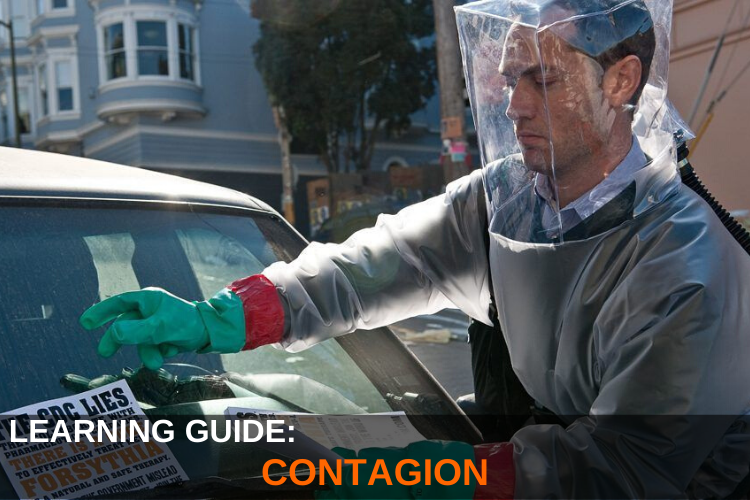
Description of the Movie: Contagion tells the tale of a fictional influenza pandemic. It is, in many ways, realistic.
Learner Outcomes/Objectives: Students will understand the risks to modern society from the influenza virus and see a realistic scenario of what might occur in case of moderately lethal influenza pandemic. Students will learn to use the Internet to obtain information on illnesses from various web sites, including cdc.gov from the Centers for Disease Control (CDC) and www.flu.gov from the U.S. Department of Health & Human Services (HHS).
View the Learning Guide to Contagion Here.
|
|
The Spread of Viral Infection
Learner Outcomes/Objectives: Students will have a clear picture of the path that a virus can take from a host animal to its first human victims and from there to an epidemic destroying an entire community.
Rationale: The film clips provide an excellent supplement to a unit on the spread of infectious disease.
Description of the Film Clip: A deadly virus is transmitted from Africa to the United States and threatens to cause an epidemic. The clips are taken from the first hour of the movie showing how the disease spreads.
View the new Snippet Lesson Plan to Outbreak Here.
|
LATEST TWM BLOG POSTS:
Pairing of Nonfiction Books and Film
Written By: Mary Red Clay (TWM contributor)
Years ago, a workbook given to students to help them prepare for a standardized test asked them to read a piece of nonfiction called "School Based Management." The students in my test prep class glanced at the title, read a line or two, and then quickly turned to the questions and penciled in the answers on the scan-tron test. Discussion ensued. I learned that the kids were certain they would do as well randomly selecting a response as they would were they to read the material and reason through to the correct answers. No way, they argued, were they going waste their time reading something so boring....[ click here to continue reading full post ]
UPDATE TO THE SCHOOL / GROUP MEMBERSHIP PROGRAM:
We added a new benefit to the School / Group Membership Program as of April 2012. Now your group will get a full 1-year membership from the date you sign up, as opposed to simply the balance of the current school year.
As before, you will save 50% to 62% off our regular low membership price by signing up under our School Membership Program.
Administrators: The cornerstone of any program to ensure that class time won't be wasted when students are shown movies is to give teachers curriculum materials that reveal the educational value of feature films. Then you can work with teachers to ensure that movies are used infrequently but with maximum educational return consistent with the Common Core State Standards.
Teachers: Join as a department to enrich your classes and meet curriculum standards.
Get more details on our new School Membership Program.
MARCH 2012
NEW TV PROGRAM WORKSHEETS FOR HOMEWORK:
Television is a multifaceted medium with programming that covers most subjects in the k-12 curriculum. There are nature shows, history documentaries, and dramas such as soaps, crime stories, and the reality survival shows. In addition, there are reality competition shows in dance, music, cooking, memory and various sports-like situations. TV also has documentary-like shows which provide important up-to-date information on the latest current events or discoveries in science. The most popular TV programs, with varying degrees of quality, are watched by millions.
The interest that students have in TV programming offers an opportunity for creative teachers to make interesting homework lesson plans for both extra credit and required homework assignments. An important additional advantage is that the TV watching will be done at home, outside of class, and will not take up instructional time.
- Fiction (Soaps, Dramas, and Reality/Survival Shows);
- Historical Fiction;
- Documentaries - Informational and Persuasive;
- Reality Show Competitions; and
- News Program.
We have a total of 6 New Worksheets!!
Click Here to view the list of TV Program Worksheets for Homework which serve as the core for TV show lesson planning.
NEW MOVIE WORKSHEETS FOR DOCUMENTARIES:
We now offer two film study worksheets designed to help teachers quickly create lesson plans based on documentary films; one is for movies that are primarily informational and the other for films designed to persuade the viewer on a matter of political or social significance.
The worksheets assist students in analyzing the documentary. They allow students to take notes during breaks while watching the movie or when the film is over. The prompts on the worksheets can be used to facilitate class discussions or form the basis for writing assignments.
The worksheets for documentaries will help students:
- determine premise, theme and intent;
- look at the structure and form of the presentation;
- summarize important facts;
- articulate important lessons learned from the film; and
- identify scenes, images, or sounds that appeal to the viewer.
TWM offers the following movie worksheets for documentaries:
- Film Study Worksheet for a Documentary;
- Film Study Worksheet for a Documentary that Seeks to Persuade on Issues of Political or Social Significance.
Click Here to view more about how to use these Documentary Worksheets in class.
LATEST TWM BLOG POSTS:
Hawthorne is to The Rolling Stones as "Young Goodman Brown" is to "Sympathy for the Devil"
Written By: Mary Red Clay (TWM contributor)
Mick Jagger cannot be duplicated. And in his early days, everyone knew those Lips and studied how he slung them around his lyrics in sync with his moves. Whether or not you are old enough to be a Rolling Stones fan, your students will enjoy watching a video of this young 60's icon as they learn the theme of one of Nathaniel Hawthorne's best short stories.
The early classics of American Literature are increasingly obscure to today's students. Most of them would prefer a mediocre film over a book any day. But Hawthorne's short story, "Young Goodman Brown," as dense and difficult as it is, redounds with ideas that are as important now as when they were written in 1835. And Jagger's "Sympathy for the Devil" makes the central idea outright obvious. Plus, it leads to a good writing assignment...[ click here to continue reading full post ]
FEBRUARY 2012
A NEW NONFICTION LEARNING GUIDE FOR INTO THE WILD:
Into the Wild tells the true story of Chris McCandless, a young man from a troubled family who was enraged by what he considered to be the moral lapses of his mother and father and their multiple failures as parents. Chris also had a love of nature and of adventuring in the wild. Upon graduating from college near the top of his class, Chris cut himself off from family and friends to go solo adventuring in the Western United States. His last trip was to the Alaskan wilderness where he was found dead of starvation in an abandoned bus, a few short miles from safety. The movie tells the story of the events at home, Chris' love of nature, his wanderings in the West, the people that he met, and, in the final weeks, his epiphany of forgiveness and his realization of the importance of human relationships.
The book, Into the Wild, by John Krakauer, is an excellent nonfiction text for students in grades 10 - 12. The film can be used to introduce students to the book or to serve as a reward after they have read the book. The TWM Learning Guide provides writing exercises for students who have seen the movie or read the book.
And don't forget the Learning Guide to Mao's Last Dancer.
NEW SNIPPET LESSON PLANS USING THELMA & LOUISE AND ONE FLEW OVER THE CUCKOO'S NEST

|
Foreshadowing and Characterization using a film clip from Thelma & Louise
Learner Outcomes/Objectives: Students will learn how to use, analyze and interpret foreshadowing and characterization through showing rather than telling.
Rationale: The first seven minutes of Thelma & Louise utilize details which foreshadow the adventure the two women are about to experience and thoroughly reveal character. These techniques can then be shown in written literature.
Description: The film begins with somber, yet inviting music that looks upon a dark road leading as in "infinite regress" to a distant mountain. The scene lightens to brilliant colors which then begin to fade as the credits finish. Eventually, all is dark except for shadows of clouds above the mountain tops. Quickly, the scene changes and we see Louise waiting tables and Thelma in her kitchen at home. Their personalities are clearly portrayed by what is shown as they decide to take the trip and do their packing.
View the Snippet Lesson Plan to Thelma & Louise.
|
| |
 |
Deriving Theme Using a film clip from One Flew Over the Cuckoo's Nest
Learner Outcomes/Objectives: Students will practice deriving theme from a scene in a novel that has been adapted to film.
Rationale: The fishing scene from One Flew Over the Cuckoo's Nest is a powerful presentation of a thematic concept. In addition, students reading Ken Kesey's novel will enjoy seeing the film's presentation of this important scene.
Description: In this classic scene from One Flew Over the Cuckoo's Nest, Randall Patrick McMurphy, played by Jack Nicholson, takes fellow inmates of the mental institution on an unauthorized fishing trip. The joyful energy spent catching the fish shows on the faces of the inmates; they have become happy, successful men rather than the troubled spirits they are at the hospital. Whether or not students read the book or see the entire movie, the snippet illustrates one of the film's ideas: society determines what is crazy and what is not crazy and this determination is created through observable behavior; in other words, crazy is as crazy does.
View the Snippet Lesson Plan to One Flew Over the Cuckoo's Nest.
|
 |
Deriving Theme By Comparing Hawthorne's "Young Goodman Brown" with the Rolling Stones' "Sympathy for the Devil"
Learning Outcomes/Objectives: Students studying American Literature will gain a sense of the writing of Nathaniel Hawthorne and see connections between his advanced thinking and similar themes found in pop culture. Students will observe the same ideas presented in two different media from two different time periods. They will practice expressing their ideas in a compare/contrast essay.
For Rationale: The comparison between American literature of the first half of the 19th century and modern rock and roll will engage students and motivate them to complete their assignments. Description of the Film Clip: Hawthorne writes about a young man who leaves his wife, Faith, to explore the dark side by going into the forest at night to see what evils lurk there. He has an appointment to meet a stranger who can be seen as the personification of the devil. The stranger shows Goodman Brown the hypocrisy and evil of the allegedly good people in his family and his town. The lyrics of "Sympathy for the Devil" communicate the same idea making reference to historical events in an echo of the examples given by the stranger. The events transcend time and are dissimilar in detail showing the broad range of evil in human affairs and the frequent duplicity in human behavior.
View the Snippet Lesson Plan for Deriving Theme.
|
LATEST TWM BLOG POSTS:
No Child Left Behind Has it All Wrong. It’s the Educators That Have Been Left Behind
Written By: Mary Red Clay (TWM contributor)
The kids have moved directly into the future. Even elementary school students are listening to their iPods, playing video games, texting, tweeting, e-mailing, prowling YouTube and watching the cooking channel. And it seems as if they’re doing it all at once...[ click here to continue reading full post ]
Using the Movie Babies to Inspire Quality Writing
Written By: Mary Red Clay (TWM contributing editor)
Not long ago in my 11th grade ELA class, a student announced to all that she was, well, with child. The class responded with a mighty “ohhhhh.” The sound, heard in muted chorus, could have signified a question, a moan of disappointment, a hint of disapproval or perhaps a basic “you-don’t-say” response. Probably given the fact that there were nearly forty students in the room, all three feelings were communicated in that “oh.” ...[ click here to continue reading full post ]
Visual Metaphors and Writing Assignments Using a Clip from Thelma & Louise
Written By: Mary Red Clay (TWM contributing editor)
A good way to teach this concept is with a snippet from Thelma & Louise that shows characterization in the opening segment. First, a brief digression...[ click here to continue reading full post ]
JANUARY 2012
MOVIES AS MOTIVATION TO READ NONFICTION:
Check with "What's new on TWM" next month when we will start "A New TWM initiative on using movies to interest students in reading nonfiction: The first guides will be to 127 Hours, Into the Wild and Mao's Last Dancer."
According to the 2010 Common Core State Standards ("CCSS"):
- Extensive research has established the need for college and career ready students to be able to independently read complex nonfiction texts;
- The majority of the required reading in worker training programs and in college is informational in nature and it is often challenging in content;
- The amount of nonfiction reading required of students in post-secondary education programs is usually greater than that required in K-12. CCSS pp. 3 & 4.
By 12th grade, the goal of the CCSS is for students to be reading in school 70% nonfiction and 30% fiction over all subject areas. See, CCSS p. 5. For ELA classes this means that perhaps 50% of the reading will be nonfiction. This new section of TeachWithMovies.com is to assist teachers in meeting these goals in a fashion that will energize kids to read the books.
UPDATED LEARNING GUIDE TO THE OX-BOW INCIDENT:
|

The Ox-Bow Incident
|
A frontier town in 1885 Nevada is rocked by news that a respected rancher has been murdered. The sheriff is out of town. Impatient townspeople form a posse. Three strangers are soon found herding cattle marked with the brand belonging to the murdered rancher. They claim they bought the cattle — but there is no bill of sale. One of the strangers has the rancher's gun. He tells the posse that he bought it from the rancher but again, he has no evidence. Most of the posse wants to string the strangers up immediately. A few men argue that the posse should wait and turn the strangers over to the sheriff. What will the posse do?
The TeachWithMovies.com Learning Guide to The Ox-Bow Incident has been completely rewritten and now contains a wealth of information about due process and how the posse in this film ignored this most basic value of the rule of law. The Guide will help teachers introduce in a graphic way the meaning and importance of due process and the risks of mob rule.
NOTE: An active TWM login is required in order to view these links.
|
NEW LEARNING GUIDE TO MAO'S LAST DANCER:
|

Mao's Last Dancer
|
The TeachWithMovies.com Learning Guide to Mao's Last Dancer will assist teachers who show the movie alone or in conjunction with reading Li Cunxin's interesting autobiography of the same title.
Li Cunxin (1961 - ) is the sixth of seven sons born to a poor, hard working peasant family in China. The Li's are loving and close, enduring decades of hunger and deprivation, barely avoiding starvation. The book describes a peasant's life in China before, during and after the Cultural Revolution (1966 to 1976). The movie is a reasonably accurate description of Mr. Cunxin's life through about his 30th year, as described in his autobiography.
NOTE: An active TWM login is required in order to view these links.
|
NEW SCIENCE SNIPPET LESSON PLANS USING THE RELIC AND DAYLIGHT
|

The Relic
|
Viruses and the Speed of Evolution Using The Relic
Students will experience an entertaining introduction to the topics of viruses and the speed of evolution using two film clips from The Relic. Three basic concepts of virology and one concept of evolution will be highlighted by the lesson. View the new Snippet Lesson Plan for The Relic.
NOTE: An active TWM login is required in order to view these links.
|
| |

Daylight
|
Oxidation-Reduction Reactions (Redox) Using a Film Clips from Daylight
In a lesson spiced with a film clip from Daylight and two interesting YouTube clips, students will learn about real life occurrences of oxidation-reduction reactions, from paper becoming yellow, to apples becoming brown, to fire, to the most destructive explosions. They will review how oxidation-reduction reactions involve electron transfer between atoms. Finally, students will receive practical advice on fire safety. View the new Snippet Lesson Plan for Daylight.
NOTE: An active TWM login is required in order to view these links.
|
DECEMBER 2011
The Wizard of OZ is a classic example of the Hero's Journey!
MOVIES AS REWARDS IN THE CLASSROOM:
Showing students movies as a reward for good behavior has its purpose.
The promise of a film as reward for tasks accomplished has always been a manipulative device favored by teachers who themselves love a good movie now and then. But reward doesn't have to mean useless or brain-dead.
Reward films are an opportunity to show students movies that are great works of art, unusual films that change lives or show a part of the world that students have never seen. It is also a reward to show students a filmed version of a book that they have read.
Finally, reward-time is a great way to expose students to foreign films.
The key is to use the class to do something different that will help students.
Click here to see our latest article about showing reward films. It includes a list of recommended movies.
NEW LEARNING GUIDES TO: Hercules & Grave of the Fireflies
|

Hercules
|
What do you do with a movie that, although loved by children, takes a Greek myth, changes the plot, modifies the characters almost beyond recognition, mixes in Christian theological themes, and adds parallels to a comic book hero?
One student told us about a class in mythology whose teacher had turned Hercules into a test. The prompt was simple: describe the ways in which the movie departs from the myth.
The TeachWithMovies.com Learning Guide to Hercules provides a comprehensive list of how the Disney version differs from the Greek myth.
|
| |

Grave of the Fireflies
|
Grave of the Fireflies is a heartbreaking film that shows two orphaned children trying to survive the aftermath of the American incendiary bombing campaign that preceded the nuclear attacks on Hiroshima and Nagasaki. It shows one example of the effects of the Second World War on civilians and provides a clear example of the tragedy hidden behind the euphemism "collateral damage." Roger Ebert wrote, "Grave of the Fireflies is an emotional experience so powerful that it forces a rethinking of animation." Another critic compared the movie to Schindler's List saying that: "It is the most profoundly human animated film I've ever seen." See Roger Ebert's Review in the Chicago Sun-Times.
The TeachWithMovies.com Learning Guide to Grave of the Fireflies shows how to use the film on its own or to supplement units on civilian casualties in WW II or in any war. The movie can also be used to support TWM's Mass Casualties Lesson Plan, which explores the decision to drop atomic bombs to end WW II.
|
SCHOOL MEMBERSHIPS NOW AVAILABLE:
Save 50% to 62% off our regular low membership price by signing up under our Group Membership Program.
Administrators: The cornerstone of any program to ensure that class time won't be wasted when students are shown movies is to give your teachers curriculum materials that reveal the educational value of feature films. Then you can work with teachers to ensure that movies are used infrequently but with maximum educational return consistent with the Common Core State Standards.
Teachers: Join as a department to enrich your classes and meet curriculum standards.
Get more details on our new School Membership Program.
NOVEMBER 2011
The Common Core State Standards and Feature Films in the ELA Classroom:
Feature films — carefully selected, properly introduced, shown with a movie worksheet, and followed by discussions and assignments — will inspire and interest today's students.
Some of the new Common Core State Standards refer to the use of film. Movies can also assist in meeting standards that make no reference to film.
Click here for an explanation of how a few carefully selected and properly presented movies can assist teachers in meeting the Common Core State Standards, including a complete list of the Common Core State Standards that relate to the use of film in education.
Helpful Tip: Are your school administrators resisting the use of film in your ELA classes? Give them TWM's article entitled Common Core State Standards and Feature Films in the ELA Classroom and the Common Core State Standards - Annotated & Highlighted for Films. These documents demonstrate that teachers cannot realistically meet the Common Core State Standards without showing some movies in the classroom and that a limited and judicious use of feature films can assist in meeting many standards.
Updated Learning Guide to Casablanca
|
 |
Casablanca a classic story of love and redemption through sacrifice at the beginning of World War II. It's one of the most popular films ever made. With its extended metaphor relating to the end of American isolationism, Casablanca can assist learning in both English Language Arts and social studies classes. The film is an excellent example of historical fiction. Moreover, the film can serve as an example of Joseph Campbell's Hero's Journey through Rick's internal quest for redemption and self-rediscovery.
The character of Rick provides an example of the value of redemption, both on a social and personal level. Watching this movie permits children to work through the issues of romantic attachment and when that attachment must be sacrificed for more important values. Because of the power of the story, Casablanca is an excellent Reward Film.
The TeachWithMovies.com Learning Guide to Casablanca provides a movie worksheet for use in ELA classes, another for an ELA class on the Hero's Journey, and a third for social studies classes (treating the film as an example of historical fiction). It contains extensive background information that will support an introduction to the film. The Guide also contains discussion questions and assignments. ...read more
|
OCTOBER, 2011
TWM is proud to present its Movies as Literature Homework Project together with a new and revised Film Study Worksheet.
ELA teachers . . . . How many of your students will frequently read books as adults? Some . . . . but they'll all be watching movies!
Help students understand that movies tell stories that can be analyzed using the elements and devices of fiction. You may change the way your students look at film for their entire lives. With TWM's Movies as Literature Homework Project YOU CAN DO THIS WITHOUT A LARGE INVESTMENT OF CLASS TIME!
Social Studies Teachers . . . . How many of your students will read books about history when they are adults? A few . . . . but most will be watching historical fiction in movies!
TWM's Historical Fiction in Film Homework Project requires students to watch, outside of class, movies that are historical fiction. They are required to analyze the films for the elements and devices of fiction and for their historical accuracy and perspective. Used with TWM's revised Film Study Worksheet for Historical Fiction this homework assignment means . . . . YOU CAN DO THIS WITHOUT A LARGE INVESTMENT OF CLASS TIME!
Music Within is a biography of Richard Pimentel, one of the people responsible for passage of the Americans With Disabilities Act of 1990. However, when properly supported by the information, discussion questions and assignments in TWM's Learning Guide, the film provides much more:
Health Classes: Students love the character of Art, a man confined to a wheelchair by cerebral palsy. Art's spastic movements make even the simplest tasks of daily life extremely difficult. Michael Sheen's portrayal of this real-life character is so engaging that the way students see and think about persons with obvious physical disabilities will change forever. The movie will also help students reach new levels of understanding about the effects of early childhood trauma, PTSD, and overcoming a dysfunctional family. Music Within is one of the best films for Health classes relating to disabilities.
Social Studies Classes: Music Within presents one of the five great advances in human rights in the U.S. during the 20th century: the movement to allow the disabled to integrate into mainstream society. It will show students that just a few years ago, disabled people could not get access to public buildings and could be discriminated against at work and in education. The movie also provides a window onto life in the last half of the 20th century.
English Language Arts Classes: The movie is an excellent description of the human condition as experienced in America during the 20th century. It vicariously expands students' experiences and raises important questions that are great topics for persuasive essays and other writing projects.
Since it is strong in so many areas, the film also offers cross-curricular benefits.
How do most students and adults in the U.S. learn about history? It's from movies and film - be it Amistad or All the President's Men or A Man for All Seasons – movies "based on" historical events appear every year. These are, in fact, works of historical fiction with varying degrees of accuracy. TWM believes that an important function of any social studies class is to help students learn to critically evaluate the historical fiction that they'll be watching the rest of their lives. We have created two new teaching tools to address this need.
Before showing a work of historical fiction, require students to read TWM's Film Study Worksheet for Historical Fiction. After the movie is over, in class or as homework, ask students to provide written responses. Alternatively, hold a class discussion based on the questions in the Worksheet. This will keep students' attention on the movie and lead them to evaluate the film as both a work of fiction and a description of history.
Because class time is valuable and there are few opportunities to show an entire movie in class, TWM has developed a Historical Fiction in Film Homework Project which requires students to watch, outside of class, a certain number of movies that are historical fiction — TWM suggests four per semester — and then respond to the questions in the Film Study Worksheet for Historical Fiction.
Once you have used the Worksheet or the Homework Project, tell us what you think via email to support@TeachWithMovies.com. Our thanks to Suzanne Paulazzo, Social Studies Teacher, Leland High School, San Jose, California for sending us a lesson plan that inspired these two new products.
HEALTH
We have updated the Learning Guide and Student Handout for Super Size Me with new statistics about the obesity epidemic. TWM recommends ten other movies that will supplement and add depth to Health classes.
FIVE NEW SNIPPET LESSON PLANS — ONE IN MATH and FIVE IN THE SCIENCES
(We can count; the first one overlaps.)
Illustrate the amazing power of exponential increase and decrease, show students the reason for scientific notation, and introduce different numeral systems with Exponents, Scientific Notation, and Numeral Systems Using Powers of Ten or Cosmic Voyage. Both films have similar scenes that will leave a lasting impression on students.
Demonstrate the vast distances between stars but the relative closeness of galaxies with Interstellar and Intergalactic Distances Using Cosmic Voyage. The Guide has links to websites with amazing photographs of galactic collisions.
Show students the optics of refraction that lie behind the rare and ephemeral Green Flash. See Refraction and the Green Flash Using a Clip from Pirates of the Caribbean: At World's End.
How can harmonic motion sink a ship, break a glass, make beautiful music, or destroy a bridge? Give examples from Hollywood (fictional) to Tacoma (real) with Harmonic Motion Using Film Clips from Pirates of the Caribbean: At World's End.
The Snippet Lesson Plan on Molecular Bonds and Surface Tension Using Film Clips from Microcosmos focuses on amazing footage of ants drinking from drops of water. It will interest students in this important topic.
ENGLISH LANGUAGE ARTS — TWO NEW LEARNING GUIDES
The Old Man and the Sea is a faithful adaptation of Hemingway's Pulitzer Prize winning novella. The Learning Guide contains a Film Study Worksheet to keep students' focused on the film and the themes of the story. The Guide will assist in teaching both the book and the movie providing insights, discussion questions, and assignments. As almost always, TWM suggests that students read the book before they see the movie.
While The Sandlot appears on the surface to be a lightweight comedy, the movie provokes an empathic reaction in virtually all viewers. The Learning Guide to this film points out the themes of the movie and provides discussion questions. It contains assignments for middle or junior high students to practice the skills required by The Common Core State Standards for English Language Arts for Writing and for Speaking and Listening.
MAY 2011
As you can see, we have a new and modernized look with new navigation tools including a search engine. Give it a drive — check it out.
We have updated the Learning Guide and Student Handout for Super Size Me with new statistics about the obesity epidemic.
TWO MORE SCIENCE SNIPPET LESSON PLANS
JANUARY 2011
USE SNIPPETS OF FEATURE FILMS TO ILLUSTRATE PRINCIPLES OF PHYSICS, BIOLOGY & EARTH SCIENCE
During 2011 TWM will present 12 new Snippet Lesson Plans illustrating principles of science. Combined with our current offerings, TWM subscribers will be able access more than 40 ways to use film in physics, biology and earth science classes to vary classroom routines and stimulate interest. See TWM's Science and Technology Index.
Our first new Science Snippet Lesson Plan is an Introduction to Volcanoes and Tectonic Plates Using "Volcano".
Students will learn about volcanoes,their likely locations, the factors that can lead to an eruption, the relation of plate tectonics to volcanic eruptions, and the kind of certainty that scientists can and cannot provide. They will become familiar with the way that volcanoes are classified and four of the important phenomena that happen before and during eruptions: heating of underground and surface water, lava flows, ash clouds, and volcanic bombs.
The Lesson Plan shows the difference between what occurs in nature and where Hollywood fantasy manifests itself in the film. The events of the movie are loosely based on real incidents in which a volcano suddenly surged to life in an unexpected location and when advancing lava was cooled and stopped with water. Comparison of the real events with the film will demonstrate the differences between fact and fiction in movies while providing interest and context for the lesson.
STUDENTS ARE FASCINATED BY THE HERO'S JOURNEY
— MAKE THIS MYTHICAL AND LITERARY STRUCTURE RELAVANT TO THE LIVES OF STUDENTS
— SHOW HOW IT RELATES TO STORIES OF ACHIEVEMENT AND PERSONAL GROWTH
Very few students will be involved in the situations and violence portrayed in today's action/adventure movies. However, most of them, at one time in their lives, will embark on their own quests for achievement or for personal growth. These quests often fit the paradigm of the Hero's Journey. TWM has developed four Lesson Plans to show that the Hero's Journey can be found in stories other than action/adventure movies. More Hero's Journey Lesson Plans will be published in the coming months.
Check out TWM's Stages and Archetypes of the Hero's Journey -- Introducing the Monomyth based on the insights of Carl Jung, Joseph Campbell and Christopher Vogler.
|
In Fly Away Home, Amy undertakes two important quests. The first is to successfully pass through paralyzing grief arising from her mother's untimely death. She accomplishes this, in part, through her second quest, a mission in which she and her father work together to teach her orphaned geese how to migrate from north to south. Both of these quests fit the paradigm of "the Hero's Journey," |
|
The "The Wizard of Oz" is another Heroine's Journey. In the process of finding her way back home, Dorothy grows in self-confidence and matures. |
|
The Hero's Journey can also be found in romantic comedies as shown by the Lesson Plan for "Big". In this case, Josh makes an internal Hero's Journey and learns that despite his desire to be big, he is not ready for the world of adults and that childhood is a time to be enjoyed. |
|
The Hero's Journey lesson plan for "Departures" shows a Journey of personal growth and development in a foreign film. |
In each of these lesson plans, students will be asked to describe the stages and archetypes of the Hero's Journey. By completing one or more of the suggested assignments, students will employ and perfect the writing skills required by ELA curriculum standards.
TeachWithMovies.com Learning Guides are designed to assist teachers in creating lesson plans. Each Learning Guide contains sections on Helpful Background, Benefits of the Movie, Possible Problems, Discussion Questions, and Assignments.
Snippet Lesson Plans are made from short subjects or from "film clips," "movie clips," or "video clips." The video segments of these lesson plans are ideal for classroom use because they are less than 40 minutes long.
Movies and films make the events they portray come alive. TeachWithMovies.com helps teachers and parents make lessons vivid and personal for children.
TeachWithMovies.com, Inc. grants to its subscribers a limited license to print Learning Guides and Indexes for classroom or personal use. Click here for details.
For instructions on printing this Index for personal or classroom use, click here.
Spread the GOOD NEWS about ...
TEACHWITHMOVIES.COM!
|
|
|